

Guides
How to Deal With Saved Articles You Never Read
Turn an overloaded read-later list into a finite queue by deciding what to read, keep as a reference, archive, or delete.

You do not need to read everything you saved, and you do not need to delete everything to start over. Treat the old collection as a library, then build a separate active queue containing only the articles you have a current reason to read. Every item in that queue needs an exit: read it, turn it into a reference, archive it, or let it go.
That change removes the false promise hidden in many read-later lists: that every interesting headline is unfinished work.
People describe the problem in remarkably concrete terms. In one public discussion, a reader said articles from blogs, newsletters, and news sites kept piling up because they never returned to them. In another, people compared small priority folders, resurfacing old items, deleting aggressively, and accepting that some collections will never reach zero. These productivity and personal knowledge management threads show how individuals talk about the problem; they are not representative studies of reading behavior.
Stop treating the whole collection as unfinished work
A backlog becomes heavy when every saved item carries the same implicit instruction: read this later. A report needed for Friday's meeting sits beside a thoughtful essay saved six months ago, three tutorials for tools you no longer use, and a reference page you already consult without ever intending to read from top to bottom.
Those links do not have the same job. Keeping them in one unread count makes the count precise but not useful.
The first move is to separate two things:
- the active queue, which contains credible reading commitments;
- the library, which contains material you may search, consult, or reconsider without owing it a complete read.
This is a status change, not a deletion spree. If an old article becomes relevant to a project next month, promote it into the active queue then. Until that happens, it is stored material, not overdue work.
If you need to decide whether a page belongs in reading, reference, archive, or nowhere, use the separate guide to bookmarks, reading lists, and archives. The method here begins after that distinction: it is about keeping the reading queue honest.
Reset the queue without reviewing every old link
Opening the oldest item and working forward sounds responsible. It also makes the reset depend on finishing a job that may contain hundreds or thousands of decisions.
Start with an empty active queue instead.
- Create a temporary list or state called Now, Active, or another name that clearly means “I have committed to this.”
- Leave the old collection where it is. If your tool supports archive or bulk movement, you may move it out of the active view, but do not delete it blindly.
- Promote an article only when it has a present trigger: a deadline, a current project question, a conversation you are preparing for, or a real opportunity to read it.
- Stop when the active queue matches the time and attention you can actually give it.
This works even in a basic browser. Use one folder for the active queue and leave the existing bookmark tree alone. The important part is not the folder name; it is that old saves no longer enter today's workload by default.
You may still choose a gradual cleanup later. It is no longer a prerequisite for reading something useful today.
Admit a new article with one sentence
Before an article enters the active queue, complete this sentence:
Before [moment or event], I will read or skim this to answer [question].
“Read the accessibility audit before Thursday's design review to check which findings affect the new form” is a commitment. “Interesting accessibility article for later” is a description of the headline.
The sentence does not need to become permanent metadata. Its purpose is to expose whether the article has a current job.
If you already know that you will consult a page repeatedly, keep it as a reference rather than pretending you plan to read it once. If the page documents a past decision, archive it with the project. If you cannot name a moment, question, or recurring use, leave it in the library—or do not save it.
This rule also protects legitimate curiosity. “Read on Saturday morning because I want to understand how this artist builds color” is specific even when no work deadline is involved.
Keep today's queue finite
Finite does not mean there is one correct number. A dense research paper may fill the available reading time by itself. Five short articles may be reasonable on another day. The queue is finite when you can see its end and make a decision about every item without scrolling through the rest of your collection.
If you want to test that capacity before rebuilding the queue, use the free reading backlog calculator. It compares your current backlog, weekly saves, and available reading time without uploading your list.
Use capacity, not aspiration:
- estimate the reading time you genuinely have;
- include the effort needed to take a note or verify a claim, not only the time needed to open the page;
- leave room to abandon an article after a useful skim;
- when the queue is full, make a new save replace something, wait outside the queue, or remain unsaved.
Do not turn the limit into another performance target. The point is to reduce the number of simultaneous promises, not maximize how many articles you can process.
Give every article an exit after the first useful pass
“Unread” and “read” are too coarse for many saved pages. After the first useful pass, choose what happens next.
| What you discovered | Next decision |
|---|---|
| The article answers the question and is worth finishing | Read it now or keep it in the active queue for a named session |
| Only one passage or idea matters | Save the note or highlight with its source, then archive or remove the article from the queue |
| The page is useful for repeat consultation | Move it to references; it is no longer a reading commitment |
| The headline promised more than the article delivered | Delete it or close it without creating another obligation |
| You still cannot judge because the topic is complex | Keep it active only if the question and next session remain concrete |
Skimming is a decision step, not a failed version of reading. It can tell you that a source is irrelevant, outdated, repetitive, or important enough to deserve careful attention. What matters is that the skim changes the item's state.
We ran the reset on this article's research pile
To make the method observable, we applied it on July 21, 2026 to six sources gathered while researching this article. This is an editorial work sample, not a user study or a benchmark of read-later tools.
| Source saved during research | Decision | Why |
|---|---|---|
| A discussion about saved articles piling up | Keep as audience-language evidence | It shows one reader's situation and wording, but cannot establish prevalence |
| A discussion about managing “later” content | Keep as a trade-off source | The comments contain different approaches, including strict deletion and deliberate serendipity |
| A study of how 50 participants retrieved previously visited sites | Keep as bounded research evidence | It tests visibility and bookmark retrieval, not whether people finish saved articles |
| An article attributing the problem to psychology and overload | Do not use as evidence | Its broad market and psychological claims are not supported with visible sources |
| A product article recommending deletion, a cap, and a morning routine | Use only to inspect the current search pattern | The fixed numbers and effectiveness claim are part of a product pitch, not demonstrated findings |
| A product guide built around a cap and weekly review | Use only to compare approaches | It explains a coherent setup, but does not establish its limits as universal |
The result was not “read all six.” Three became cited references with explicit limits; three left the evidence queue after serving as competitor or search-pattern checks. None remained as a vague promise to read later.
This is the difference between a large source collection and a reading backlog. The collection may stay large. The active queue should contain only unresolved work.
Visibility helps, but it does not prove completion
A bounded retrieval study gives one useful warning about buried collections. Researchers asked 50 participants to retrieve previously visited websites. Of 250 targets that were in participants' bookmarks, only 41 were retrieved through the bookmark feature; 32 of those 41 were found in the visible browser bar rather than the menu hierarchy. The authors concluded that bookmarks were rarely used unless they remained highly visible.
That study measured retrieval, not reading habits, and its numbers should not be presented as a universal read rate. Still, the design implication fits a finite queue: an item that matters now should be visible now. The rest can remain searchable without competing for today's attention.
Adapt the method when the stakes are different
A finite queue is a working model, not a reason to discard material that must be preserved.
- Academic or legal research: keep complete citations and required records in the appropriate system. Reading status and preservation status are different things.
- Fast-moving project research: organize the active queue by the decision or deadline it supports. It may be larger for a short period, but today's view can still be bounded.
- Serendipitous reading: maintain an interest library that carries no promise of completion. Browse it when you want; do not count it as overdue.
- Feeds and news streams: treat them as streams, not lists you must finish. Save only the individual pieces that earn a concrete next action.
The method also fails when the active queue becomes another hiding place. If items can enter without a reason and stay without a next session, the new list will slowly reproduce the old backlog under a cleaner name.
How Nodus Vault makes the queue visible
Nodus Vault separates Triage, Reading List, and Archive. Daily Check then brings back a finite queue of up to five eligible links, one decision at a time. You can read, complete, move an item to trash, or stop it from being suggested again.
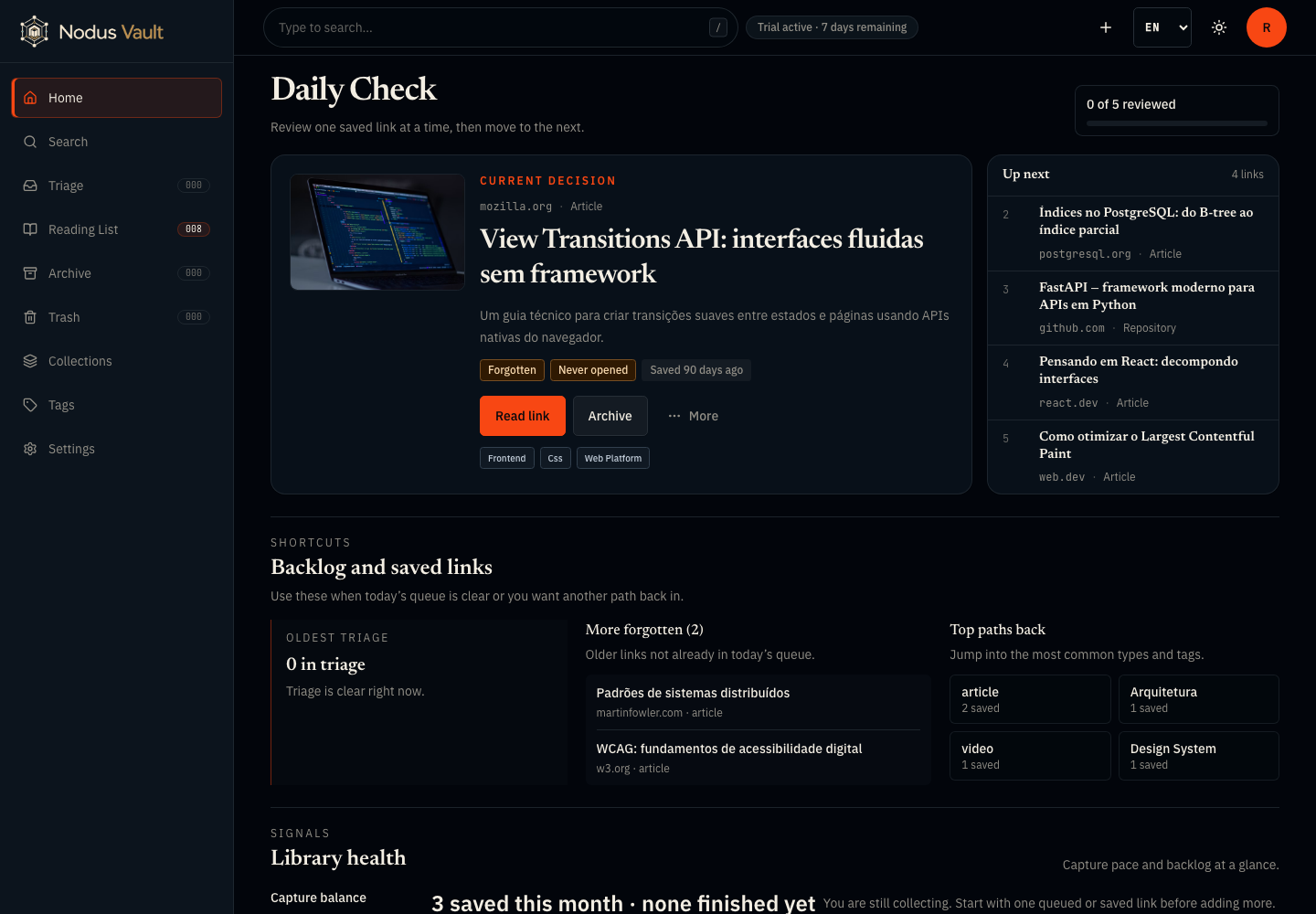
The current English interface on July 21, 2026. This is a prepared product demonstration, not a behavioral study. Five is the product's upper bound for Daily Check, not a claim about the ideal number of articles for every reader.
You can use the same method in a browser folder, a notes app, or another read-later tool. Nodus makes the separation explicit and brings a small set back into view; it does not make every saved article worth reading.
Keep the queue honest
Your saved library may never be empty. That is not automatically a problem. The problem is allowing every saved page to behave like an overdue task.
Reset the active queue, admit articles with a current reason, and require an exit after the first useful pass. When a new link cannot earn a place today, it can wait outside the queue—or leave entirely.
Try the finite queue in Nodus Vault with articles you already care about. Start with one real commitment, not the oldest item in the pile.