

Guides
How to Keep Track of Articles You’ve Read—and Find Them Later
Use a 90-second after-reading pass to keep the useful idea, route the article, and create a clue you can search later.
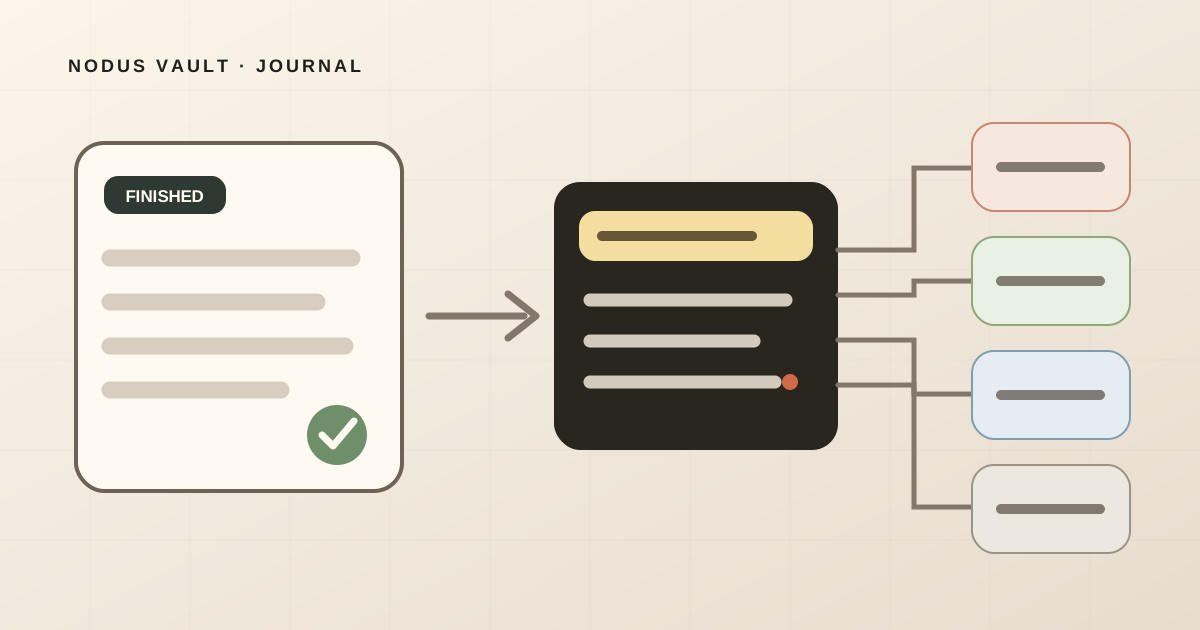
Finishing an article is not the same as making it useful later. When the reading is worth keeping, spend 90 seconds recording one idea in your own words, one reason you may need it again, and one destination for the link. Then move the article to active work, reference, archive, or discard.
That small after-reading pass creates a clue you can actually search. It also stops every finished article from remaining in the same undifferentiated pile.
This guide starts after you have read or meaningfully skimmed the page. If the real problem is an unread backlog, use the separate process for saved articles you never read. If the article is a formal research source, the more detailed four-field reference method is a better fit.
Keep a memory line, not a miniature summary
A long summary is expensive to write and still may not contain the phrase you will remember. A highlight preserves the author's words, but your future memory may preserve the implication instead.
Write one sentence that joins the idea to a possible use:
Search clue: A two-pass note process keeps the first reading light; use this when the research pile grows faster than the draft.
That sentence contains a concept, a contrast, and a future situation. “Good article about notes” contains none of them.
The University of Toronto's guidance on taking notes from research reading recommends selecting relevant ideas, using your own words, and labeling notes for later use rather than depending on highlighting alone. Concordia Library describes a compatible two-step process: minimal notes during initial sorting, then deeper notes for the sources that prove relevant.
Those sources address academic reading, so their citation requirements are stricter than an everyday article library. The transferable part is narrower: your own words make a better return path than a color or a generic “important” label.
Give the article one of four destinations
The memory line answers why the article matters. Its destination answers what the link is doing now.
| Destination | Use it when | What happens next |
|---|---|---|
| Active work | The article changes a current draft, decision, meeting, or project | Attach it to that work and name the next action |
| Reference | You expect to consult the idea or page again | Keep the link and memory line searchable |
| Archive | The article influenced finished work, but needs no attention now | Preserve the trail without leaving an open task |
| Discard | Nothing changed, the source is weak, or the useful point already lives elsewhere | Remove the link instead of keeping a vague obligation |
“Read” is not a destination. It is an event that already happened. Leaving finished articles marked only as read tells you nothing about whether they deserve another visit.
The distinction also protects a reading list. An article can leave the queue after you finish it, even when the source stays in your library as a reference. For the broader routing logic, see bookmarks versus reading lists.
Run the 90-second after-reading pass
Use the same sequence while the article is still open:
- Name the useful idea. Write one sentence without copying the title.
- Name the return condition. What project, question, decision, or conversation would make you reopen it?
- Keep the source attached. Preserve the URL and, when citation matters, the author, publication date, and exact passage.
- Choose a destination. Active work, reference, archive, or discard.
- Test the clue. Ask whether the sentence would distinguish this page from five similar articles next month.
If the test fails, add one concrete anchor: a surprising fact, the source, a person, a method, a counterargument, or the decision it changed. Do not solve ambiguity by adding ten tags.
A useful final record can be very small:
Source: Taking Good Notes, Concordia Library
Memory line: Start with two or three lines, then deepen notes only for sources that survive relevance screening.
Destination: Reference for editorial research methods.
We tested the pass on this article’s eight-source working set
On August 18, 2026, we applied the pass to eight pages gathered while researching this guide. We hid the page titles and judged each record using only its domain and memory line. A card passed if an editor could say both why the page might be reopened and what decision it could support.
This was a same-session editorial exercise, not a user study, a delayed-memory experiment, or a benchmark of reading apps.
| Source in the working set | First-pass result | Editorial decision |
|---|---|---|
| University of Toronto note-taking guidance | Passed: the note named own-word summaries and later grouping | Keep as the main rationale for the memory line |
| Concordia Library note-taking guidance | Passed: the note distinguished light sorting from deeper notes | Keep as support for the 90-second pass |
| Kennesaw State research log | Passed: the note named source details plus the reader's response | Keep for higher-stakes research boundaries |
| Iowa State source-tracking chapter | Failed: “useful source tracking chapter” did not name a future use | Rewrite with the specific citation-trail purpose |
| Instapaper organization overview | Passed: the note identified folders as a product-specific organization option | Archive after competitor inspection |
| A personal reading-organization workflow | Failed: “interesting workflow” preserved no decision | Discard as evidence; retain only as search-pattern context |
| A public reading-tracker discussion | Passed with a limit: it captured audience language, not prevalence | Keep only as anecdotal language evidence |
| A public read-later-system discussion | Passed with the same limit | Keep only as anecdotal language evidence |
Six first-pass cards met the criterion. Two vague notes failed. We rewrote the Iowa State card because it had a clear supporting job; we removed the personal workflow from the evidence set because it changed no claim. The useful result was not a perfect score. It was an explicit decision for every source.
The exercise also exposed a limit: a clue that feels obvious immediately after reading may still fail weeks later. A same-session test can catch vague wording, but it cannot prove durable recall. The low-cost follow-up is to search for one of the records after a day or a week using only the words you remember.
Search with the words you wrote, then verify the source
When you need the article again, begin with the memory line—not a guessed title. Search for the project, decision, unusual fact, or contrast you recorded. If your tool supports notes and full text, try your own wording first and a phrase from the page second.
Once a result appears, verify it:
- reopen the original page;
- confirm that the passage still supports your memory line;
- check the author, date, and surrounding context before citing it;
- treat a changed or unavailable page as a source problem, not as permission to rely on the note alone.
A note is a retrieval aid. It is not proof that the source still says the same thing, and a URL is not an immutable archive.
Use a stricter system when the stakes are higher
The 90-second pass is for articles you want to rediscover and use. It is not enough for every context.
- Academic, legal, medical, or audit work: keep the required bibliographic details, versions, page numbers, and authorized records. Follow the rules of the institution or profession.
- Claims you expect to publish: preserve the exact passage and its qualifiers, then verify the live source during editing.
- Sensitive or restricted pages: do not copy content into another service unless you are authorized to do so and understand where it will be stored.
- Material that must survive page changes: use an appropriate preservation or records system. A saved link can break.
Kennesaw State's research log model keeps each source's identifying information beside quotations, paraphrases, and the reader's response. That is deliberately more complete than the everyday card in this guide.
Where Nodus Vault fits after you finish reading
In Nodus Vault, a note stays attached to the saved link. Search indexes titles, descriptions, available page text, notes, tags, sources, and other saved context; the interface can show the matching evidence behind a result. After reading, you can keep an item as a reference, move finished material out of the active queue, or archive it. Daily Check can bring back up to five eligible links for a decision.
These statements were checked against the current search document, ranking and explanation paths, interface copy, and automated tests on August 18, 2026. They have boundaries: some pages do not yield readable text, semantic search can degrade to lexical search, and a page that was never explicitly saved is outside the Nodus library. Nodus is also not an immutable web archive or a formal citation manager.
You can apply the same method in browser bookmarks or a notes app. Nodus is useful when you want the source, your memory line, the reading decision, and later search to stay in one workflow.
Make one finished article prove the system
Do not reorganize your entire reading history. Choose one article you finished this week.
Write one memory line, give the link a destination, close it, and search for it tomorrow using your own words. If it returns and the note tells you why it matters, keep the method. If it does not, improve the clue before you add more articles.
Try that single after-reading pass in Nodus Vault. The useful outcome is not another saved link; it is one idea you can find and verify when you actually need it.